

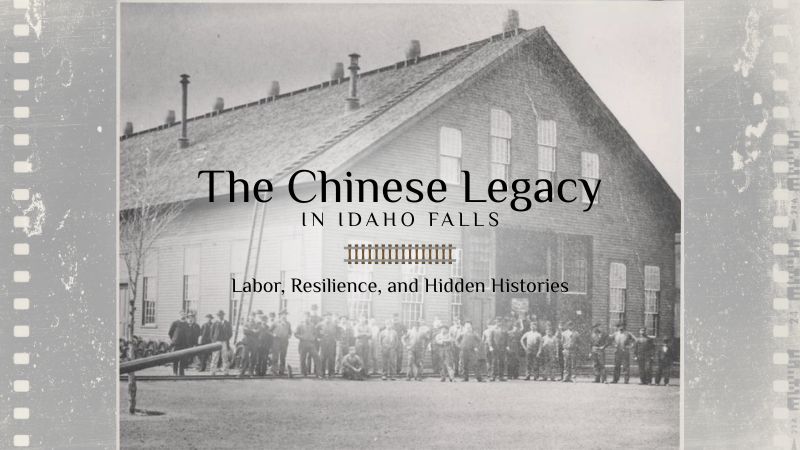
The history of Idaho Falls is inseparable from the contributions of Chinese immigrants, though their stories have too often been overlooked or minimized. From the 1870s onward, Chinese laborers were integral to the development of eastern Idaho, working primarily on railroad construction, in mining, and later in service industries. Their presence was especially visible during the boom of the Utah & Northern Railroad, which crossed through Eagle Rock (now Idaho Falls), linking the region to the rest of the American West.
Chinese workers were instrumental in the physical building of the railroad that gave Idaho Falls its start. Without their skill and endurance—often under punishing conditions—the Snake River crossing would not have become the economic artery it did. Many Chinese immigrants also opened laundries, restaurants, and other small businesses that served the burgeoning town’s needs.
Despite their contributions, the Chinese community faced exclusion and violence, especially following the Chinese Exclusion Act of 1882. In Idaho Falls, as in much of the West, discriminatory laws and social hostility forced many Chinese residents to the margins of town life. The Chinese enclave near the tracks—sometimes referred to colloquially as “Chinatown”—was both a vibrant cultural center and a symbol of forced segregation.
One particularly vivid story passed down involves a local Chinese herbalist known as “Doc Hing,” who was respected across racial lines for his medical remedies and whose clientele included both Chinese and non-Chinese residents. His practice became legendary in Idaho Falls for treating everything from minor ailments to more serious conditions when Western doctors were scarce.
A lesser-known but compelling chapter ties directly to the same island where Idaho Falls’ most notorious brothels once stood. Oral histories suggest that Chinese immigrants, along with other marginalized groups, also lived and worked near that area, making it a microcosm of Idaho Falls’ multiethnic and complex past.
Though much of the tangible heritage—like buildings and street markers—has disappeared, the legacy of the Chinese community remains woven into Idaho Falls’ early development. The Underground Files are dedicated to bringing their stories back to the surface, recognizing the endurance and dignity of a people who helped build the foundation of the city, even as they were too often written out of its official history.
Credits:
Idaho Falls Historical Society: Records on Chinese Railroad Workers, 1870s–1900s
Museum of Idaho Archives: Oral Histories of Chinese Herbalists and Merchants
Transcripts from the 2025 Untold Stories event at The Soiled Dove, with Chloe Doucette and Jeff Carr