

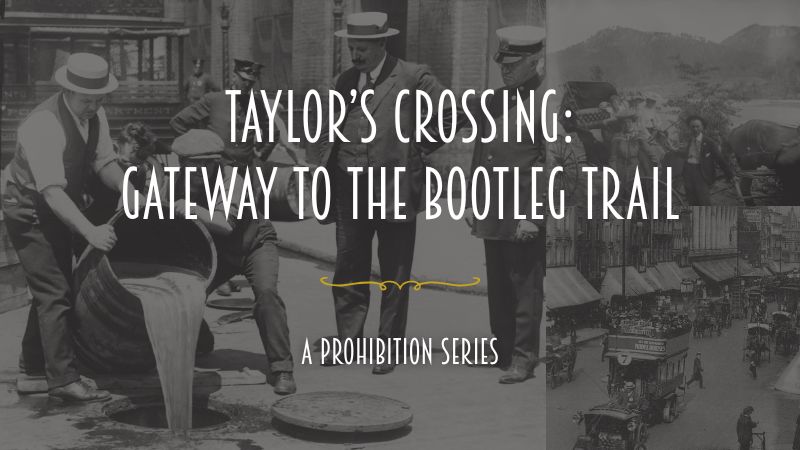
When Prohibition clamped down on the nation in 1920, Idaho Falls was already four years deep into its own dry spell. Idaho had gone dry early, enacting statewide Prohibition in 1916—long before most Americans had to think twice about ordering a whiskey. That head start gave bootleggers in Eastern Idaho a running leap into the underground market, and by the time the national Volstead Act kicked in, Idaho Falls was well-oiled in the ways of rebellion.
At the center of it all was Taylor’s Crossing, a rough patch of bridge and dirt roads that became the lifeblood of local bootlegging. Named for Matt Taylor’s original ferry and bridge, Taylor’s Crossing sat just far enough from town to dodge prying eyes but close enough to keep the liquor flowing fast. The Snake River bridge served as a secret handshake, linking hidden distilleries, roadhouses, and smugglers with thirsty customers across East Idaho, Montana, and Wyoming.
By the mid-1920s, Taylor’s Crossing wasn’t just a backroad shortcut—it was a pipeline. Farmers distilled moonshine in barns hidden by thick willow groves. Railroad workers, whose tracks skirted the edge of town, often doubled as smugglers, sliding bottles into freight cars or ferrying them across state lines in false-bottomed crates. Some of the city’s most respectable faces—business owners, even local officials—were whispered to have stakes in the trade, profiting from what many saw as a crime in name only.
Early Prohibition also sharpened the bootleggers’ skills. Idaho’s dry law pushed smugglers to build their networks fast and fine-tune their evasion tactics. When national Prohibition kicked in, Idaho Falls’ black market was already seasoned—slick enough to keep ahead of law enforcement, whose raids were often foiled by well-placed tip-offs and backroom deals.
Taylor’s Crossing was the artery of it all, a place where danger, commerce, and secrecy met in equal measure. Today, it’s just another quiet intersection by the river, but if the Snake could talk, it would spill tales of midnight crossings, whispered deals under rattling planks, and a town that, for a time, made an art of defying the law.
This is just the first pour of a much larger story—a glimpse into Idaho Falls’ shadowy Prohibition past. Stay tuned as we dive deeper into the runners, the speakeasies, and the scandals that turned Taylor’s Crossing into a legend.
Credits:
This story is part of The Underground Files, an ongoing historical storytelling project by The Soiled Dove.
Research and writing by The Soiled Dove Historical Society.
Special thanks to the Idaho Falls Public Library’s Local History Collection and the Museum of Idaho Archives.
Finalized and archived in The Underground Files, 2025.