

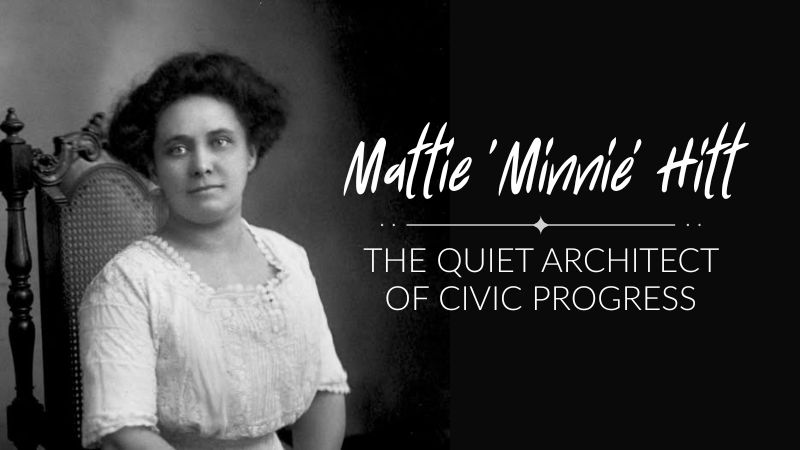
In the bustling civic transformation of Idaho Falls in the early 20th century, one woman stood quietly but firmly at the helm of progress: Mattie “Minnie” Hitt. While others made headlines, Minnie made change. Born in the 1860s and arriving in Idaho Falls before it bore its current name, Minnie helped lay the moral and civic foundation of a town struggling to evolve from a frontier outpost into a livable, prosperous city.
To appreciate Minnie’s accomplishments, it helps to understand the world she navigated. In the rough-and-tumble Wild West, banking was a man’s world—dominated by rough-handed businessmen, railroad magnates, and the grizzled veterans of frontier commerce. Women were expected to manage households, not ledgers. Yet Minnie Hitt worked in the banking sector, earning respect not only for her sharp mind but for her steady leadership in a space few women ever entered. She was trusted with money, with strategy, and with community trust at a time when women had not yet won the right to vote.
Minnie worked under the influential Taylor family, whose patriarch, Matt Taylor, was instrumental in the founding of what would become Idaho Falls. Taylor was a freighter and entrepreneur who recognized the economic potential of the Snake River crossing and built the original Taylor’s Bridge—a critical link for miners, settlers, and traders headed west. The site, later known as Taylor’s Crossing, was the spark that ignited Idaho Falls’ growth. The Taylors operated the general store and early financial operations that served as the economic lifeblood of the town. Working alongside them, Minnie witnessed—and helped steward—the transformation of Idaho Falls from a dusty outpost into a structured city.
Minnie Hitt became one of the founding members of the Village Improvement Society, an all-women’s civic organization that—without access to formal political power—wielded tremendous influence in shaping the city’s public spaces, infrastructure, and community standards. The group’s earliest accomplishments included planting trees, organizing street clean-ups, and petitioning for sidewalks and sanitation. But it was more than beautification; it was reclamation. Minnie and her cohort sought to make Idaho Falls a place where women, children, and families could thrive—a place safe from the shadowy corners of vice that had once defined the Eagle Rock railroad town.
Minnie brought strategy to the movement. While her name does not appear often in public addresses or political editorials, her hand can be traced in meeting minutes, committee rosters, and handwritten petitions that circulated through city hall. She was the type of leader who recruited others, quietly brokered alliances, and then let more vocal figures take the spotlight. But make no mistake—she was indispensable.
In the early 1900s, the Village Improvement Society successfully petitioned for ownership of what is now the Japanese Friendship Garden, then a notorious island of brothels and jailhouses. The land was deeded to the women with the condition that they “clear it of its current inhabitants,” a task they accomplished through legal channels and civic pressure. That reclaimed island—once known locally as “Soiled Dove Island”—would become a symbol of the city’s transformation.
Minnie Hitt’s legacy is not one of notoriety or scandal but of tenacity, vision, and civic discipline. In a time when women were often denied official leadership roles, she built power through community and left a footprint still visible in the parks, sidewalks, and civility of modern Idaho Falls.
Her history is rarely told. But at The Soiled Dove, we toast to the ones who kept things interesting.
Credits + Sources:
City of Destiny: A History of Idaho Falls by Mary Jane Fritzen
Museum of Idaho Archives – Village Improvement Society Minutes
Idaho State Historical Society – Taylor’s Crossing documents and early business registries
U.S. Census Records (1900–1920) referencing Mattie M. Hitt Sanborn Fire Insurance Maps (1890–1910), Idaho Falls region
The Women’s West by Susan Armitage and Elizabeth Jameson (context on women in frontier civic life)