

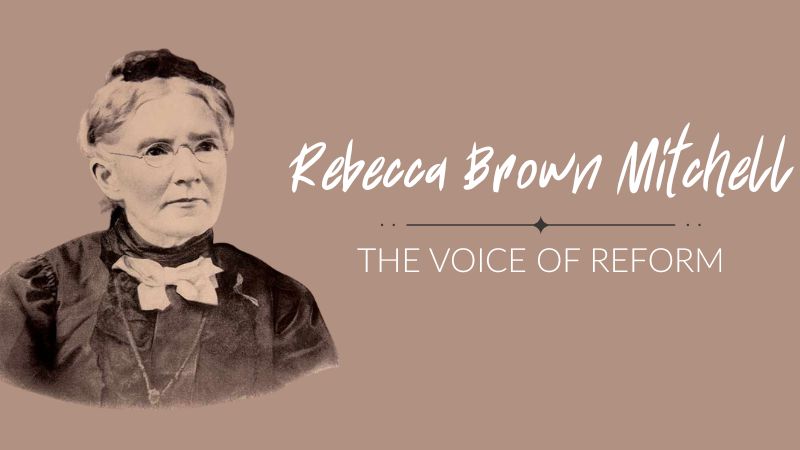
In the wake of scandal and violence in 1890s Idaho Falls, when saloons and brothels outnumbered churches and schools, one woman stood apart as a moral force. Rebecca Brown Mitchell, dressed in black and backed by conviction, led the charge to change the trajectory of the community. Her writing, organizing, and outspoken criticism helped Idaho Falls shift from a frontier town steeped in vice to a place that would embrace temperance, women’s rights, and civic progress.
Born in 1831, Mitchell moved to Idaho Falls in her later years as a missionary and teacher associated with the Baptist Church. But she was far more than a quiet moralist. Mitchell became an early force behind the Women’s Christian Temperance Union (WCTU), a national movement to curb alcohol consumption and advocate for women’s suffrage, protection for families, and the welfare of children. She also became one of the state’s most influential advocates for women’s property rights and legal protections at a time when few women had access to any political voice.
Her defining moment in Idaho Falls came in June of 1897, following the murder of Josie Hill and the public spectacle surrounding her killer, Sid Larkins. The newspapers of the day sensationalized the story, glamorizing Sid as a repentant sinner while dragging Josie through the mud as a “Siberian sorceress” and “infamous courtesan.” Women reportedly sent Larkins flowers in jail; the public seemed more taken with his gallows-bound dignity than the suffering of the woman he had murdered.
Mitchell’s public response came in a scathing letter to the editor titled “Defense of the Ladies.” Published in local and regional newspapers, her words cut through the narrative like a blade:
“If flowers were sent him, it was probably done by some man who secretly honored him for his unrepentant demeanor, which they call pluck… Go, ye men of Idaho, who put the bottle to your neighbor’s lips, that bottle that so often becomes a spade digging graves for murdered men and women — go, take her a flower. Poor victim of sin, she needs from this hour the compassion of men.”
She called Josie a “charming heroine,” flipping the narrative completely. She defended her not for what she had done, but for what she had suffered. She reminded readers that the real corruption was not in Josie, but in the culture that allowed women like her to be exploited and discarded.
Mitchell didn’t stop there. She worked to ensure that women had a place in civic life. As a leading member of the Village Improvement Society, she helped secure land that would eventually become today’s Japanese Friendship Garden. She advocated for women’s suffrage and helped lead the charge that allowed Idaho to grant women the right to vote in 1896—a full 24 years before the 19th Amendment was ratified nationally.
Mitchell died in 1907, leaving behind no children, but an army of women empowered by her voice, her example, and her refusal to stay silent.
Today, efforts are underway to honor her legacy with a permanent public memorial. She deserves it. Because while some men swung from gallows and others faded into the background of early Idaho, Rebecca Brown Mitchell stood tall. And her voice still echoes.
Credits + Sources:
“Defense of the Ladies,” Letter to the Editor, Idaho Register, June 1897
Museum of Idaho archives, Village Improvement Society minutes
Women’s Christian Temperance Union Records
Idaho State Historical Society, Biography Files