

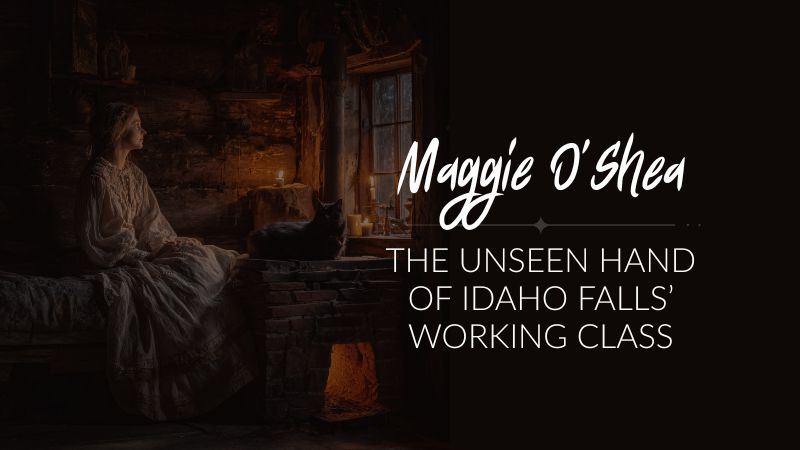
Before Prohibition and the rise of the bootlegging era, Idaho Falls was shaped by a different kind of pioneer spirit—one built by the tireless efforts of working-class women who held the community together behind the scenes. Among them was Maggie O’Shea, a laundress, midwife, and occasional activist whose quiet resilience left a lasting imprint on the town’s early days.
Born in the 1870s to Irish immigrant parents, Maggie arrived in Idaho Falls (then Eagle Rock) in the late 1890s. At a time when opportunity for women was scarce, Maggie carved out a reputation for grit and dependability. Her small laundry business served not only railroad men and miners but also some of the town’s more prominent families, bridging class divides in unexpected ways.
But Maggie’s true legacy lay in her work as an unofficial midwife and caregiver. In an era when formal medical care was rare and expensive, she was often the first—and sometimes only—person women turned to for help during childbirth or illness. Stories abound of Maggie walking miles through snowstorms to reach isolated farms, delivering babies by lantern light, and staying on for days to tend to new mothers and their families.
Maggie also became an unlikely voice for women’s welfare. She was known to speak up at town meetings and was rumored to have helped organize early gatherings of the Village Improvement Society. Though she never held public office, her influence was felt in small, persistent ways that shaped the fabric of daily life in Idaho Falls.
She passed away in 1932, just before Prohibition ended, and was remembered by locals not for wealth or notoriety, but for embodying the quiet strength that defined much of Idaho Falls’ early history.
Today, Maggie O’Shea’s story serves as a reminder that while history often highlights the loudest voices, the true backbone of a community is built by those who work tirelessly in the background.
Credits + Sources:
This story is part of The Underground Files, an ongoing historical storytelling project by The Soiled Dove.
Research and writing by The Soiled Dove Historical Society.
Special thanks to the Idaho Falls Public Library’s Local History Collection and the Museum of Idaho Archives.
Finalized and archived in The Underground Files, 2025.