

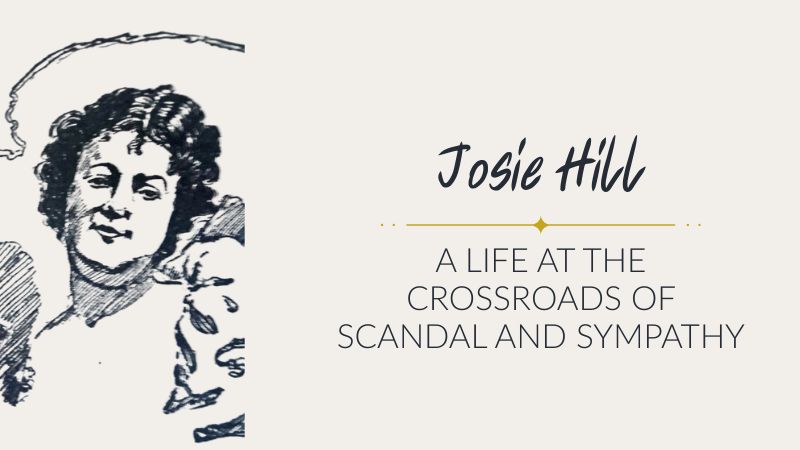
Before she ever set foot in Idaho Falls, Josie Hill was already a name spoken in scandal and suspicion. Her story begins in Salt Lake City in June of 1891, when Josie—already working in sex work like her mother—was with a man named Ed Callahan the night he was murdered. He had been flaunting cash that night, and newspapers reported he and Josie were seen together until 3 AM, when they were allegedly attacked by highwaymen near some hot springs. Callahan was shot and killed. Josie survived. While at least eight men were considered suspects, it was Josie’s name that appeared in every headline.
In a hearing reported by the Salt Lake Herald in February 1892, Josie was examined alongside others including Sid Larkins and Lottie Miner. Witnesses testified to seeing Josie and Callahan in a buggy just before the murder, including accounts of them riding out of town near hot springs where the robbery occurred. This part of the story—that Josie and Callahan were in a buggy when highwaymen allegedly attacked and killed him—is uncontested. Other testimony placed them at Lottie Miner’s house earlier in the evening, adding layers of ambiguity. Though never convicted, Josie remained a central figure in the unsolved case.
The press dubbed her a “Cyprian,” a “Siberian Sorceress,” and worse. Though she was never convicted, she was marked. Her relationship with James Sidney “Sid” Larkins—a jealous gambler she met prior to the Callahan murder—only added fuel. Sid claimed to love her deeply. They lived together in Salt Lake for a time, but Josie was drawn back into sex work, allegedly under pressure from her mother. At one point, Sid even paid to send her mother back to Ireland to free Josie from her influence. It didn’t work.
Josie eventually left Utah, arriving first in Idaho Falls around 1894. There, she rented a room on what is now the Japanese Friendship Garden island—then known to locals as “Soiled Dove Island.” There were only two buildings: the jail and a house of sex work. Police collected fees from the women there in what they referred to as a “Soiled Dove tax.”
But her time in Idaho Falls was brief. At her mother’s urging, Josie relocated to Boise and resumed sex work there. It wasn’t long before Sid followed her. Discovering she had returned to her former life, Sid became enraged and begged her to come back to Idaho Falls. For reasons unknown—love, exhaustion, financial need—Josie relented.
She returned to Soiled Dove Island and again tried to start fresh, but Sid’s presence made that impossible. He was violent and jealous. He assaulted her and was arrested, then released. He returned to the island, drunk and unstable, and threatened to kill her. According to witnesses, she dared him to go through with it.
He did. On Christmas morning, 1895, Sid shot her in the back with a stolen gun. She didn’t die immediately. Over nearly two weeks, Josie clung to life. Townspeople hoped she might confess to Callahan’s murder, but she never did. Her silence became one of the great unsolved threads in Utah’s criminal history.
After her death, the national press turned her life into pulp: a cautionary tale of desire, danger, and downfall. But to women like Rebecca Brown Mitchell, Josie wasn’t a seductress or a symbol. She was a person. In an open letter titled “Defense of the Ladies,” Mitchell wrote, “Poor victim of sin, she needs from this hour the compassion of men.”
Josie Hill never received justice or redemption in her lifetime. But her legacy—like the island where she died—was eventually transformed by the very women who fought to reclaim decency and dignity in Idaho Falls. In 1904, the Village Improvement Society, led by Mitchell and others, legally acquired the island. They cleared it of its tenants and began reshaping it into a civic space. Today, the same land where Josie took her last breath is home to weddings, festivals, and cherry blossoms.
Credits + Sources:
Salt Lake Times, June 1891 archives
Salt Lake Herald, February 10, 1892, “Criminal Matters: Developments Yesterday in the Callihan Murder Case”
Idaho Falls Times, Dec. 1895–Jan. 1896 archives
Transcripts from the 2024 Untold Stories event at The Soiled Dove, programmed by Museum of Idaho staff Chloe Doucette and Jeff Carr
Rebecca Brown Mitchell, “Defense of the Ladies” letter, June 1897
Sanborn Insurance Maps, Idaho Falls 1895–1905
Interviews with Museum of Idaho staff